
The complete guide
A Buyer's Guide to Choosing and Playing a Giant Tumbling Tower
A party game needs to fit the people, the space and the kind of gathering you have in mind. Some games ask everyone to sit down for a long session. A stacking tower gives a small group something physical to gather around, with a clear task on each turn and a visible change after every move.
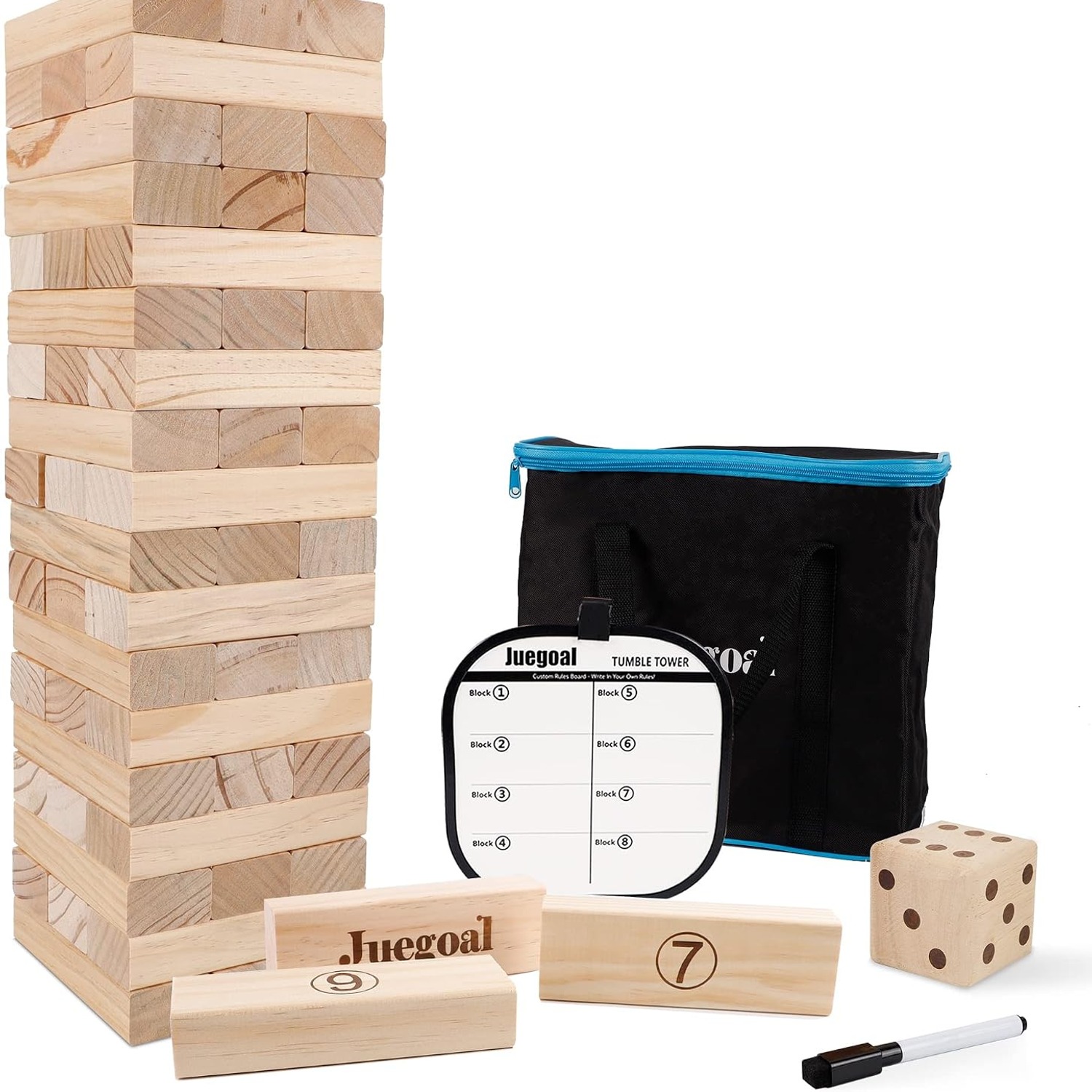
This Giant Tumbling Tower is a 54-piece wooden set for two to four players. It includes a die and a carrying bag, with indoor and outdoor use listed. Before choosing it as a backyard party game, it helps to understand its size, how the rounds work and what the supplied measurements do and do not tell you.
How the tower game works
Start by placing three blocks side by side. Add another layer of three at a right angle to the first, then keep alternating the direction. With all 54 blocks used, the starting tower has 18 rows.
Players take turns taking a block from the tower and placing it on top. The structure changes with each move. Gaps appear lower down while new layers form above them, leaving the next player with a different choice.
Eventually, a move brings the tower down. In the described game, the player whose turn causes the fall loses that round. The blocks can then be collected and stacked again.
That simple pattern is the main appeal of a wooden stacking game. The action is easy to explain, but you cannot know in advance which block will move freely or how long the tower will stand. Agree on any extra restrictions before starting so everyone plays by the same rules.
What is included in this set
The listed contents are 54 wooden blocks, one die and a black canvas carrying bag with handles. Six blocks have markings that can be used for your own variations.
The description identifies the block wood as pine. It does not give a specific finish, coating or timber certification, so those details should not be assumed from the appearance of the set.
A printed rulebook is not listed as included. For a casual game, the basic alternating-layer setup gives you a starting point. If you want a more structured round, write down your house rules before the first move.
The bag gives all the loose pieces a place between games. It also matters when the set travels, since carrying a tower's worth of blocks individually would be awkward. Count the blocks and put the die away after each session rather than leaving the next group to search for missing pieces.
Understand the size before ordering
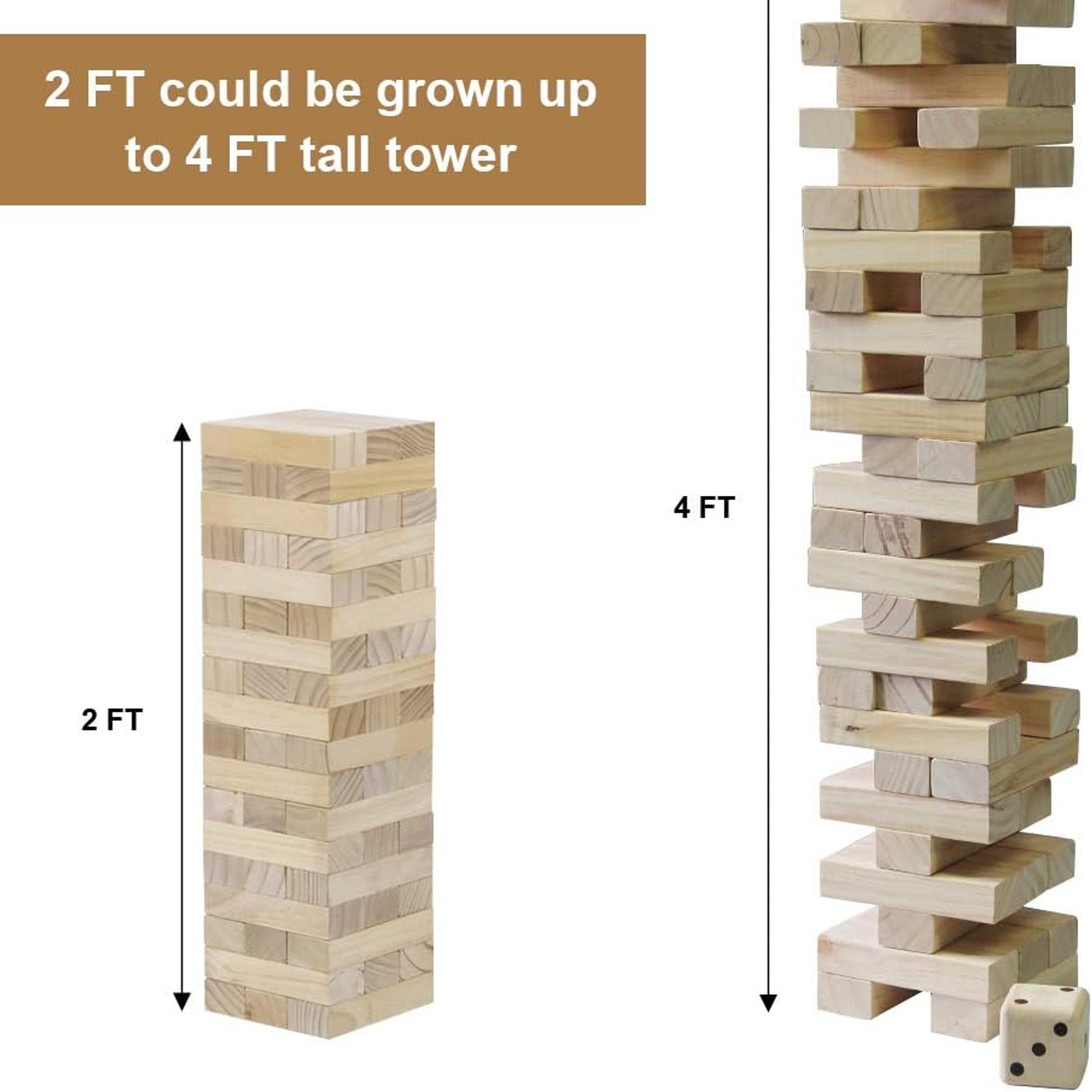
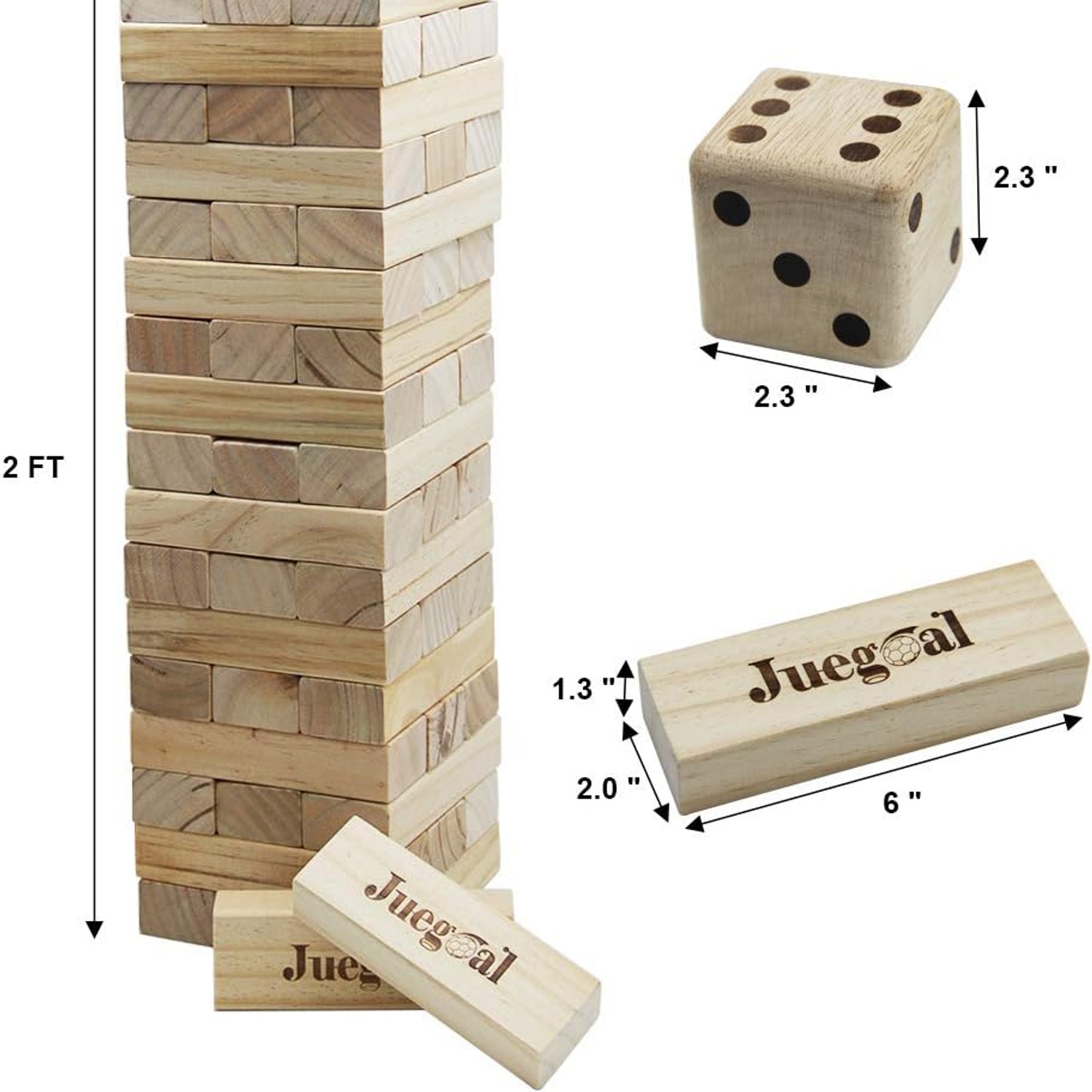
The blocks are listed as 6 x 2 x 1.3 inches each. The described starting tower measures 6 x 6 x 23.5 inches, and the product has a 2 FT size designation.
During play, it may reach up to 4 FT as blocks move from lower layers to the top. Treat that as a possible result, not a promised height. Some rounds will end much earlier, depending on the moves made.
There are also other measurements in the maker's description. One entry gives 22.9 x 10.2 x 20.3 cm, while another gives 59.7 cm long by 15.2 cm wide. The maker does not clearly explain which configuration each entry measures.
If you are buying for a tight storage space or a fixed playing area, ask for clarification first. Do not use the smallest recorded dimensions as proof that the full assembled tower will fit there. The individual block size and described tower layout are more useful for picturing how a round looks.
Choose the playing space, not just the occasion
An outdoor tower game needs a suitable base. A firm, level surface makes more sense than uneven grass, where the starting stack may lean before anyone has taken a turn.
Leave clear space around the tower for pieces to fall. Keep drinks, plates and breakable objects away from that area. Choose a spot where passing guests will not brush against the stack on their way elsewhere.
For an indoor game, think about the floor and nearby furniture as well as the tower's footprint. The blocks spread beyond the base when they fall. A narrow gap between seats is not the same as an open playing area.
Outdoor use is listed, but weatherproofing is not. Plan to bring the pieces inside when play ends, and avoid wet ground or rain. A garden party game can be used outside without being designed for permanent outdoor storage.
Who this tower may suit
The stated player count is two to four. That suits a small group taking turns around one tower. At a larger gathering, people can rotate between rounds rather than all trying to play at once.
It may fit a picnic, birthday gathering or an afternoon at home when a hands-on game is wanted. Consider whether the group enjoys a game that ends with falling blocks and a reset. That is central to the format, not an occasional side effect.
Age suitability needs more care. The scraped record contains a Baby age entry, but it does not give a clear minimum playing age supported by useful guidance. That entry should not be treated as approval for infant play.
If you are choosing a family stacking game for children, confirm the appropriate age guidance before ordering. The word family describes a style of gathering, not a reliable safety age.
Using the die and marked blocks
The basic stacking round can be played without adding dice rules. That is a sensible way to let everyone understand the tower before introducing extra steps.
The included die and six marked blocks offer room for house rules. The maker gives an example in which the number rolled decides how many blocks a player must move. Your group can decide whether to use that variation.
Keep any new rule easy to remember. Explain when the die is rolled, what a marked block means and when a turn finishes. Unclear rules can interrupt the round just as someone is choosing a block.
There is no need to use every feature every time. A wooden tower with dice can still be played as a straightforward stacking game. Save the variations for a group that wants them, rather than making the first round harder to explain.
Taking the game to a gathering
The listed set weight is 6.02 kg. That is an important detail if your picnic site is a long walk from the car or you are already carrying food and chairs.
The handled canvas bag keeps the set together, but it does not make the contents lighter. Think about who will carry it and where it will sit during the journey. A portable tower game is most useful when its packed weight fits the trip you actually plan to make.
Before leaving, check that all 54 blocks and the die are present. At the venue, keep the bag somewhere dry and easy to find for packing up.
If the game is for a specific date, check the delivery estimate for your address before ordering.
Care after a round
Simple care starts with keeping the wood dry. Wipe the blocks with a soft, dry cloth after use, and avoid soaking them to remove dirt.
If pieces become damp, allow them to dry before putting them back in the bag. Packing damp wood into a closed storage space is something to avoid. Store the complete set indoors in a dry place between gatherings.
Check the blocks for damage before the next game. Put aside any piece that needs attention rather than adding it to the tower without a look.
Use pack-up time to count the set. A 54 piece tower game needs its full block count to recreate the listed 18-row starting layout. Keeping the die in the same bag also saves a separate search when someone wants to try a rule variation.
Buying it as a gift
A giant tower gift is worth matching to the recipient's space and habits. Someone who hosts small gatherings may have a clear use for it, while someone with very limited storage may find the set less practical.
Check age guidance if children will be involved. Also consider the 6.02 kg weight if the recipient needs to carry it upstairs or take it to parks.
For a date-specific gift, review delivery timing before paying. Keep the return terms in mind too. The supplied policy states 14 days from delivery for a set that is unused, complete and in its original packaging.
The short version
Choose this Giant Tumbling Tower if you want 54 wooden blocks, a die for optional rules and a carrying bag for a two-to-four-player game. Its described starting tower is 23.5 inches tall, with rounds potentially growing higher as play continues.
Make the practical checks first. Confirm age suitability, allow clear space for falling blocks and account for the carrying weight. With those points settled, you can decide whether this block stacking party game fits your next gathering.